Why Your Body Suddenly Jolts As You’re Falling Asleep
Why Your Body Suddenly Jolts as You’re Falling Asleep
If you’ve ever been drifting off to sleep and suddenly felt your body jerk—like you’re falling, stumbling, or being startled awake—you’re definitely not alone. It can feel strange, sometimes even a little alarming, especially if you’re seeing it happen to someone else.
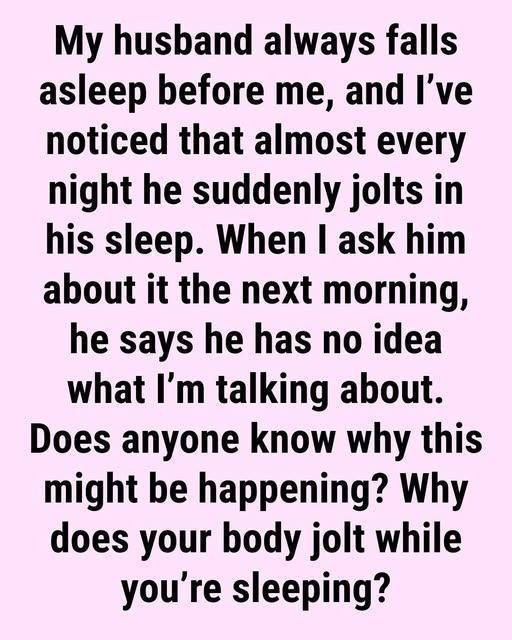
Many people notice it in their partners too. One person falls asleep peacefully, and just as they’re about to fully drift off, their body suddenly gives a quick, involuntary jolt. Then they continue sleeping as if nothing happened. The next morning, they often have no memory of it at all.
So what exactly is going on here?
Is it normal? Is it something to worry about? Or is it just one of those odd quirks of the human body?
The answer is actually quite fascinating—and completely natural.
The name for that sudden jolt
What you’re describing is most commonly known as a hypnic jerk (also called a sleep start).
It’s a sudden, involuntary muscle contraction that happens as a person is transitioning from wakefulness into sleep. It can affect the arms, legs, or the whole body, and it often comes with a feeling of falling or slipping.
One moment you’re relaxed and drifting off… and the next, your body gives a quick “startle” response.
Then it’s over.
And most of the time, the person doesn’t even realize it happened.
Why does it feel like you’re falling?
One of the most common sensations associated with a hypnic jerk is the feeling of falling.
This is not random.
As your body begins to fall asleep, your brain starts to relax muscle control. At the same time, your brain is still partially active and sometimes misinterprets this relaxation as actual falling.
In response, it triggers a sudden muscle contraction—like a reflex—to “catch” you.
It’s almost like your brain is saying:
“Wait—are we falling? Better wake the body up just in case!”
Even though there is no real danger.
What causes these sleep jerks?
There isn’t one single cause, but several factors can make hypnic jerks more likely.
1. Fatigue and lack of sleep
When you are extremely tired or sleep-deprived, your nervous system can become more sensitive during the transition into sleep. This increases the likelihood of sudden muscle spasms.
Ironically, being very exhausted can make it harder to fall into smooth, uninterrupted sleep.
2. Stress and anxiety
A busy mind doesn’t shut down instantly when the body tries to sleep. Stress keeps parts of the brain active, and this can interfere with the natural sleep transition.
This can lead to:
Sudden muscle twitches
A feeling of alertness right as you’re falling asleep
Interrupted sleep onset
People under stress often experience hypnic jerks more frequently.
3. Caffeine and stimulants
Coffee, energy drinks, nicotine, and even some medications can stimulate the nervous system.
If consumed late in the day, these substances can make it harder for the brain to fully relax, increasing the chance of sudden sleep movements.
4. Exercise timing
Intense physical activity right before bed can keep the body in a heightened state of alertness. While exercise is healthy, timing matters.
A body that is still “revved up” may struggle to transition smoothly into sleep.
5. Irregular sleep schedule
Going to bed at different times every night can confuse your body’s internal clock. This inconsistency can affect how smoothly you fall asleep, sometimes increasing muscle twitches during the transition phase.
Recent Articles

How Atorvastatin Works – And Why Side Effects Can Appear

Soak Your Feet in Vinegar Once a Week and Watch These 9 Health Problems Disappear

MYTH OR MEDICAL REALITY: DOES EATING RAW ONIONS REALLY CAUSE THIS COMMON HEALTH PROBLEM? (THE TRUTH REVEALED)